

Key Takeaways
- Mastering camera settings — aperture, shutter speed and ISO — is the foundation of capturing genuine family moments, especially with active kids in unpredictable light.
- Natural composition techniques like the rule of thirds, leading lines and candid burst shooting consistently produce more emotionally resonant family images than rigid posing.
- Environmental storytelling and thoughtful background choices turn a good family photo into a timeless keepsake that reflects who your family truly is.
Camera Settings That Capture Real Family Moments
There's no magic single setting for family photography — but there is a smart starting point for each situation. Getting these fundamentals right means you'll spend less time fixing problems in editing and more time being present with your subjects.Aperture and Depth of Field
Aperture is your depth-of-field controller, and in family photography it makes an enormous difference. For individual portraits, open up to around f/2.8 to separate your subject from the background with pleasing blur. For group shots where you need everyone sharp, pull back to f/4–f/5.6. Resist the temptation to shoot wide open at f/1.4 for group work. You'll likely find one parent razor-sharp and the other already drifting out of focus — which looks more experimental than emotive.Shutter Speed for Moving Children
Kids don't pause for cameras. They sprint, tumble, and launch themselves at siblings without warning. Freeze the action with a minimum shutter speed of 1/250s for walking subjects, and push to 1/500s or faster when the chaos really kicks in — park visits, birthday parties, backyard play. For candid conversational moments where subjects are relatively still, 1/125s is usually sufficient and gives you more flexibility with ISO and aperture.ISO in Real-World Conditions
Modern cameras handle high ISO remarkably well. Most current mirrorless and DSLR bodies produce clean results at ISO 1600, and many perform beautifully up to ISO 3200 in warm indoor settings like living rooms or our studio environment. A useful rule of thumb:- ISO 400–800 — bright outdoor shade or overcast days
- ISO 800–1600 — indoor natural light near windows
- ISO 1600–3200 — dim interiors, evening outdoor sessions
- ISO 6400 and beyond — emergency use only; noise management becomes significant
Focus Techniques for Active Families
Autofocus Modes That Actually Help
Single-point autofocus gives you precise control over exactly where the camera locks on — ideal for portraits and composed moments. Switch to continuous autofocus (AI Servo on Canon, AF-C on Sony/Nikon/Fujifilm) when children are moving unpredictably through the frame. Face and eye detection, now a standard feature on most modern mirrorless cameras, is a genuine game-changer for family portrait sessions. It tracks individual faces across the frame as people move, which frees you to focus on prompting authentic interactions rather than chasing focus points manually.Back-Button Focus: A Pro's Best Habit
Decoupling focus from the shutter button — known as back-button focus — is one of the single most useful technique changes a photographer can make. It lets you pre-focus on a spot and recompose without refocusing, and removes the risk of inadvertent focus shifts in tricky low-light conditions. Set up one rear button (typically AF-ON) to control focus acquisition, and leave your shutter button purely for exposure capture. It takes a week to feel natural and a lifetime to appreciate. ---Exposure Modes That Work in Shifting Light
Outdoor family sessions — especially across South-West Sydney's mix of sunny parks, leafy bushland reserves and golden-hour suburban streets — involve constantly shifting light. The right exposure mode makes this manageable.- Aperture Priority (Av/A) — Your go-to for outdoor sessions. Set your creative aperture, let the camera adjust shutter speed as clouds drift across the sun.
- Manual mode — Best reserved for controlled studio environments where light is consistent and predictable.
- Spot metering — Invaluable when shooting into bright skies or strong backlighting. Meter from the subject's face to ensure proper exposure regardless of what's happening in the background.
- Matrix/Evaluative metering — Works well in even, consistent lighting but can struggle in high-contrast family scenarios like dappled shade or sunset sessions.
How to Frame Family Moments That Feel Natural
Technical settings get you a sharp, well-exposed image. Composition turns that image into something you want to hang on your wall.The Rule of Thirds and Leading Lines
Divide your frame mentally into a three-by-three grid. Placing key subjects — a child's eyes, a couple's faces — on the intersection points rather than dead centre immediately adds visual interest and a sense of ease to the composition. Leading lines are equally powerful. A garden path, a staircase railing, even the natural alignment of bodies in a family group can draw the viewer's eye directly to the emotional centre of the image. Seek these out rather than placing everyone in a flat horizontal line.Dynamic Angles and Diagonal Energy
Flat, parallel compositions tend to produce static images. Introducing diagonal lines — whether through camera angle or subject positioning — adds energy and movement. Placing a family group at a 45-degree angle to the frame, for instance, creates visual depth and keeps the viewer's eye travelling through the photograph rather than sitting passively at its centre. Get low for wide-angle shots that include children at their own eye level. Get high for overhead group shots that emphasise intimacy and togetherness. Vary your angles deliberately, not randomly. ---"The most powerful family photographs aren't made in the moment of the posed smile — they're found in the three seconds before and after, when people forget the camera is there."---
Capturing Authentic Family Connections on Camera
Posed family portraits have their place — they're classic, timeless, and clients genuinely love them. But the images that make people cry years later are almost always candid. The sibling whispering something ridiculous into a baby's ear. The dad's face when his daughter runs to him. The mum who doesn't realise she's being photographed as she watches her kids play.Burst Mode and the Art of Waiting
Set your camera to continuous drive mode (burst shooting) and keep your finger ready during natural interactions. A tickle fight, a piggyback ride, kids chasing each other around a park in Gregory Hills or Harrington Park — these produce ten frames of blur and one extraordinary image of pure joy. That one frame is worth the entire session.Direct Prompts That Create Real Reactions
Rather than asking families to "smile at the camera," try interaction prompts:- Ask parents to whisper something they love about their child into their ear — on the count of three.
- Tell the kids to show their best "silly face" — then capture the parents' genuine reaction.
- Have the family walk together toward you naturally, talking about their day.
- Ask older siblings to teach the younger ones a secret handshake they make up on the spot.
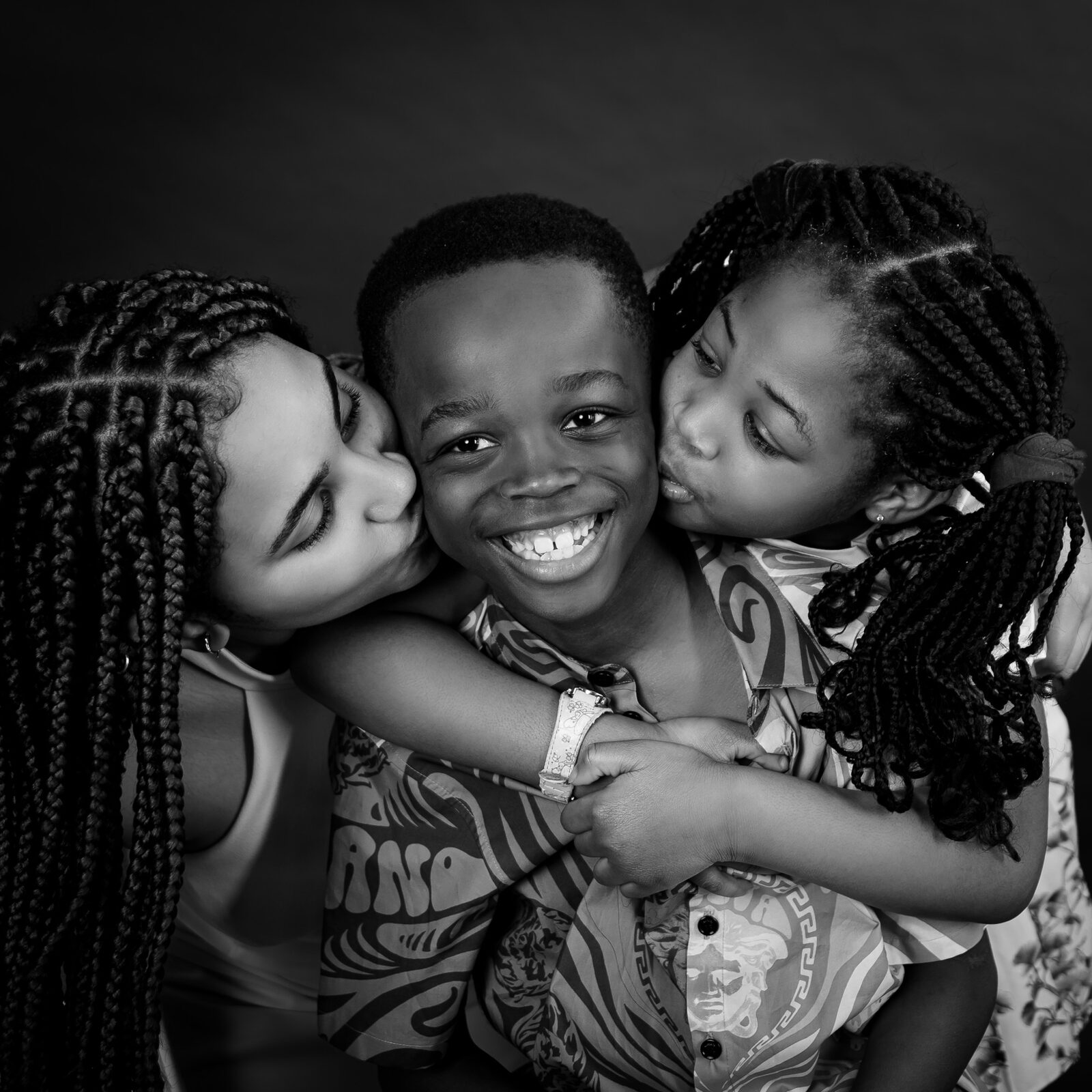
- Invite the whole family to pile onto mum or dad for a group hug on your signal.
Ready to Capture Your Family's Story?
Our team at Faithful Photography specialises in family photoshoots across Sydney and the Macarthur region — candid, warm and genuinely you.
Environmental Storytelling Through Background Choices
The background of a family photograph is never just background — it's context. It tells the viewer where these people live, what they love, and who they are beyond the frame.Choosing Locations That Mean Something
A family's backyard garden, a local park where the kids play every weekend, the coastal reserve they visit each school holidays — these locations carry emotional weight that a generic studio backdrop can't replicate. When families from Campbelltown and surrounding suburbs book location sessions with us, we always ask: *where does your family feel most like yourselves?* That said, a well-designed studio environment provides controlled, beautiful light and removes the visual clutter of busy outdoor settings. Our Glen Alpine and Gledswood Hills studios are designed to be warm, calm spaces that feel like home rather than a production set.Simplify the Background, Amplify the Subject
Wherever you shoot, the fundamental rule holds: the background should support the subject, never compete with it. Look for:- Soft, out-of-focus greenery that frames without distracting
- Clean architectural lines — walls, fences, doorways — that add visual structure
- Consistent tones and colours that don't fragment the eye across the frame
- Natural frames within the environment: tree canopies, archways, open doorways
Why Working With a Professional Makes the Difference
All of the above — aperture, focus modes, composition, candid prompts — requires simultaneous execution in real time, often with unpredictable children and fading golden-hour light. It's a lot to manage while also being emotionally present with a family. Professional photographers at studios like Faithful Photography bring not just technical expertise but years of reading family dynamics. We know when to step back and let a moment breathe. We know when a gentle prompt will unlock something genuine. And we know how to see the light — in a South-West Sydney backyard on a summer afternoon, in the soft glow of our studio at Glen Alpine, or in the way overcast skies flatten shadows and make a toddler's eyes absolutely luminous. Whether you're exploring newborn photography in Sydney to welcome a new arrival, booking an extended family session for a reunion, or simply wanting beautiful portraits of your family at this exact stage of life — the investment pays dividends for decades. ---Frequently Asked Questions
What's the best camera setting for photographing kids who won't sit still?
Use continuous autofocus (AF-C) paired with a fast shutter speed of at least 1/500s to freeze movement. Burst mode is your friend — fire multiple frames during active moments and select the sharpest, most expressive result. Aperture Priority mode with a moderate aperture of f/4–f/5.6 keeps multiple children in focus simultaneously while you concentrate on the moment.
How do I get natural-looking family photographs instead of stiff posed shots?
Replace posing instructions with interaction prompts. Ask the family to do something together — whisper a secret, share a joke, walk and talk — and photograph the genuine reactions rather than a manufactured smile. Arrive early, let children warm up to the environment and camera, and stay ready in burst mode so you capture the in-between moments that hold the real emotion.
What time of day is best for outdoor family photography in Sydney?
The golden hours — the first hour after sunrise and the final hour before sunset — produce the most flattering, warm and dimensional light for family portraits. Overcast days are also excellent, as cloud cover acts as a natural softbox and eliminates harsh shadows. Midday sun in Sydney is generally too harsh and contrasty for flattering family photography.
Does Faithful Photography offer sessions outside the studio — at parks or family homes?
Yes. Alongside our studios in Glen Alpine and Gledswood Hills, we offer location sessions across South-West Sydney and the Macarthur region, including Campbelltown, Camden, Narellan, and surrounds. Location availability is discussed at the time of booking. Visit our family photoshoot page for session details, or book directly online.
How do I choose the right aperture for group family photos?
For groups of three or more people arranged in depth (some closer, some further from the camera), use f/4–f/5.6 as a starting point. If your family is arranged in a flat line at the same distance from the camera, you can open up slightly to f/2.8 for a softer background. Always check your depth of field in the preview — it's better to be a stop too narrow than to find a family member soft in post-production.
What should my family wear for a photography session?
Coordinated tones work far better than identical outfits. Choose a colour palette of two to three complementary colours and let each family member express their personality within that range. Avoid bold logos, heavy patterns or very bright whites that can dominate the frame. Our detailed guide on family portrait wardrobe styling covers this by season with practical examples.
Visit Faithful Photography Today
We'd love to help you preserve this season of your family's life in images that are honest, warm, and entirely your own. Our studios are based in Glen Alpine and Gledswood Hills, and we welcome families from across Campbelltown, Camden, Narellan and the wider Macarthur region, NSW.