

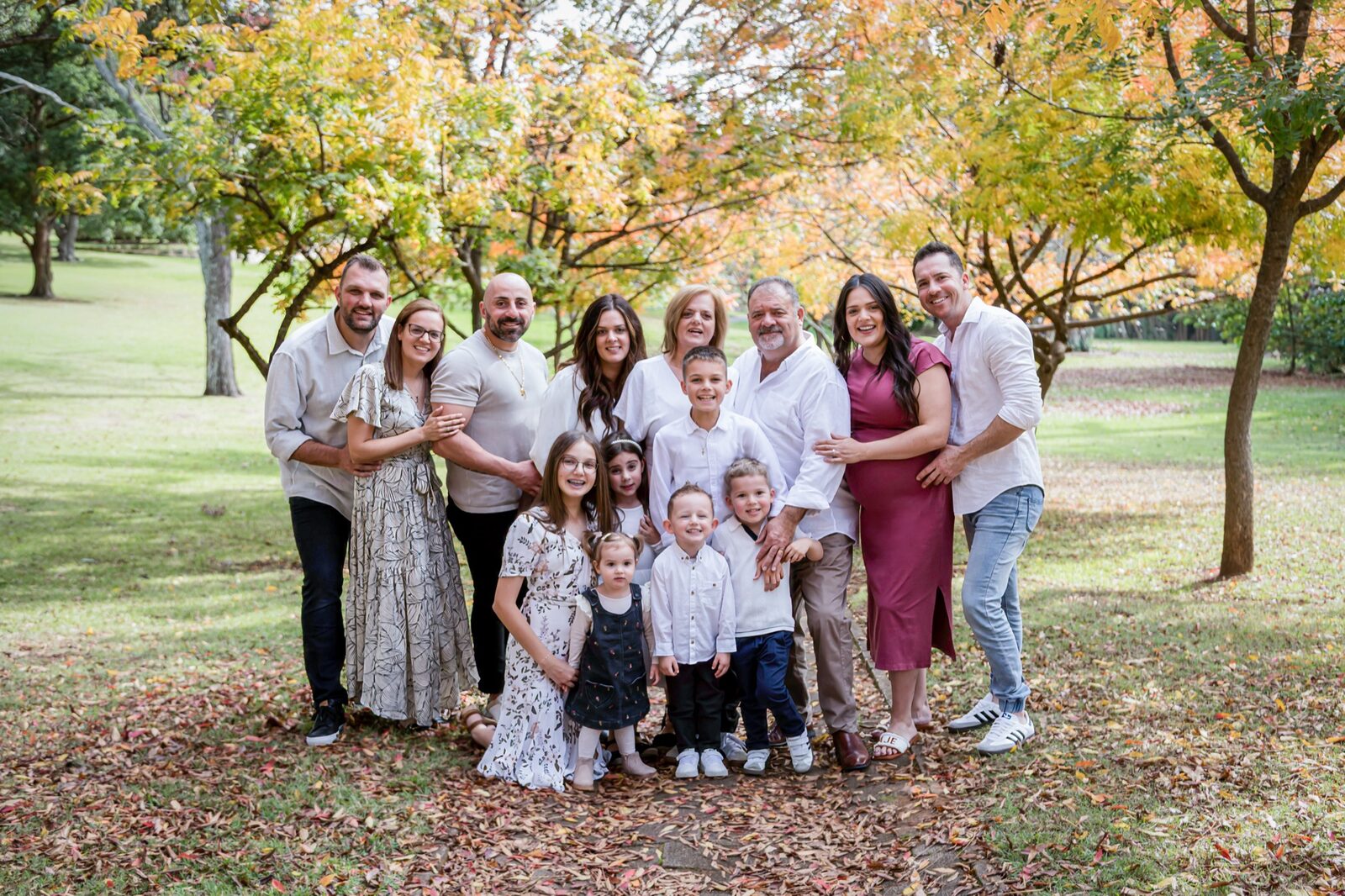
Key Takeaways
- The most common awkward family photo poses — rigid lineups, forced smiles and stiff staged contact — kill genuine connection before the shutter even fires.
- Small intentional adjustments to height, overlap, body angle and movement transform a stilted shot into something that actually looks and feels real.
- A professional photographer who understands how to direct families — not just position them — is the single biggest factor in getting portraits you'll actually want on your walls.
Family photos are supposed to feel like memories — not like everyone has been summoned to a mildly uncomfortable queue. And yet, scroll through any phone gallery and you'll spot the same cast of characters: the rigid shoulder-to-shoulder lineup, the vacant group grin, the hug that clearly isn't happening. These awkward family photo poses are so common they've become a cliché — and the worst part is most families don't even realise it's happening until the images come back and nobody wants to print them.
At Faithful Photography, our studios in Glen Alpine and Gledswood Hills serve families across South-West Sydney — from Campbelltown and Camden through to Narellan and the wider Macarthur region — and we've spent years watching perfectly lovely families get flattened by a single stiff moment. The good news? Every one of these poses has a fix, and most of them are surprisingly simple.
The Lineup Problem: Photography's Most Cringe-Worthy Default
The rigid standing line is the most recognisable awkward family photo pose in existence — and it shows up like clockwork. Everyone shoulder-to-shoulder, facing the camera dead-on, arms either locked at their sides or crossed defensively. The result looks less like a family portrait and more like a team photo for a company nobody particularly wants to work for.
Why the Lineup Falls Flat
The problem isn't just aesthetic. When people stand in a uniform row with equal spacing between them, the frame reads separation rather than unity. There's no depth, no layering, no visual suggestion that these people actually like each other.
- Equal gaps between bodies — creates a registry of individuals, not a connected family.
- Uniform height — removes visual interest and makes the image feel flat and static.
- Arms at the sides — dead weight that drags the energy of the entire image downward.
- Everyone facing forward — feels rehearsed, almost confrontational, with zero sense of relationship between the people in frame.
And then there's the forced smile. A smile that only involves the mouth — with eyes that stay glassy and cold — is immediately readable as performance rather than feeling. Real smiles engage the orbicularis oculi, those tiny crinkles around the eyes that researchers call Duchenne markers. Without them, the whole frame screams "we're enduring this."
How to Break the Alignment Without Breaking a Sweat
The lineup is easy to dismantle once you know what you're replacing it with. The goal is varied height, intentional overlap and directional diversity — three things that signal connection without anyone having to perform it.
Build Tiers, Not Rows
Sit some family members, stand others, let someone lean against a surface or crouch down. When bodies occupy different levels in the frame, the eye has somewhere to travel — and that movement creates visual warmth. It also encourages physical closeness that happens naturally rather than being staged.
Overlap and Angle
Put someone slightly in front, let shoulders touch rather than leaving a careful gap between them. Turn bodies at a slight angle — a three-quarter turn toward the camera, or toward each other, feels human in a way that a straight-on pose never quite does.
- Start with the tallest family members slightly offset — not centred, not symmetrical.
- Bring smaller children or seated adults forward, creating natural depth in the frame.
- Turn everyone's body angle in slightly, so bodies point toward the group rather than the lens.
- Allow natural overlap — shoulders, arms, even a hand resting on someone's back.
- Check hands last: they should be doing something — resting, holding, touching — not hanging.
A great family photoshoot in Sydney isn't about everyone hitting a mark perfectly. It's about creating a composition that suggests the warmth your family already has.
The Forced Smile: Why Asking "Say Cheese" Is the Problem
Here's the thing about asking a family to smile on command: it works on nobody older than about four. Everyone else produces a polite approximation of happiness that the camera sees straight through. The forced smile is arguably the single most common reason otherwise well-composed family portraits end up feeling hollow.
What to Do Instead
Stop asking people to smile. Ask them to think of something instead. A shared memory — a ridiculous family holiday moment, a private joke, that time Dad misjudged a step in front of everyone — triggers real emotion without the mime act. The smile that follows is involuntary, which means it's genuine.
- Have family members look at each other rather than the camera — interaction replaces performance.
- Encourage light touch — a real hug, heads together, a hand on a shoulder — because physical contact naturally unlocks expression.
- Give kids a small task (count to three, whisper a secret to Mum) to redirect their attention from the lens.
- Let parents pick up toddlers mid-giggle rather than waiting for everyone to settle and compose themselves.
"The best family portraits aren't captured — they're released. Our job as photographers is to create the conditions where real feeling surfaces on its own."
When Staged Physical Contact Kills the Shot
Forced physical contact in family portraits reads exactly like what it is: choreography. A hug where bodies don't actually make full contact, arms draped at unnatural angles, faces turned politely away — the camera collects all of it and reports back faithfully. Staged contact is one of the most reliably cringe-worthy outcomes in family photography.
The Poses That Almost Always Fail
- The back-to-back lean — visually hollow; signals two people who have chosen to face different directions rather than each other.
- Perching in a lap — when a person sits stiffly on the edge of someone's knee rather than actually settling in, the tension is visible in every line of their posture.
- The around-the-shoulders arm that isn't — an arm draped without pressure, without weight, without any sense that it actually wants to be there.
- The symmetrical bookend hug — everyone pressed in from both sides with equal force, like a very polite sandwich.
These poses fail because they ask people to perform intimacy rather than feel it. The camera doesn't interpret intention — it reads the tension in shoulders, the hard lines in spines and the empty millimetres between bodies.
Ready to swap cringe for connection?
Our South-West Sydney studio team knows exactly how to draw out genuine warmth from every family — no forced smiles, no awkward poses, just real portraits you'll actually love.
Real Touch Versus Staged Positioning: The Difference Is Everything
Authentic contact happens when people move naturally toward each other — and the resulting body language is completely different to anything staged. A parent's arm around a child's shoulder works because that is genuinely how they stand. A sibling leaning into another's side reads as comfort because it is comfort, replicated in front of a lens.
How to Encourage Genuine Contact
The trick is to give families permission to interact rather than instructions on how to pose. Ask a dad to whisper something funny to his kids. Ask older siblings to carry or piggyback younger ones. Have a mum rest her forehead against her partner's — it's a small, private gesture that photographs with enormous warmth.
For extended family sessions, this becomes even more important. The larger the group, the harder it is to manufacture connection — and the more vital it becomes to work with relationships that already exist. Grandparents with grandchildren, cousins together, siblings in pairs — breaking a large group into natural sub-units and building from there produces images that feel cohesive rather than assembled.
Sitting and Leaning: Getting It Right
Sitting arrangements often go wrong because people perch rather than settle. When a child sits in a parent's lap, they need to actually sink in — relaxed weight, leaning back, comfortable. The moment they hover or hold themselves upright, the tension reads immediately. Similarly, when adults lean against each other, the lean needs to commit: head on a shoulder, weight actually transferred, bodies in real contact.
Wardrobe Choices That Work Against You
Clothing is doing more work in your family portrait than most people realise. The wrong wardrobe amplifies every posture problem — stiff fabrics create rigid lines, clashing colours fracture the eye across the frame, and matching outfits (rather than coordinated ones) can make even genuine connection look planned to within an inch of its life.
What to Wear — and What to Avoid
- Avoid stiff, structured fabrics that don't move with the body — they telegraph rigidity even when posture is relaxed.
- Skip matching uniforms — coordinated palettes look intentional without looking staged; identical outfits look like a costume decision.
- Neutral and jewel tones photograph consistently well; neon colours and washed-out pastels compete with faces for attention.
- Avoid large logos or busy prints — they draw the eye away from expression and connection.
Our detailed guide to family portrait wardrobe tips for every season walks through exactly how to coordinate your family's look without ending up in accidental matching t-shirts. It's worth a read before your session.
Movement: The Most Underused Tool in Family Photography
Nothing breaks the stiffness of a posed family portrait faster than movement. When people are walking, laughing mid-step, spinning a toddler, or just shifting their weight, the brain stops performing for the camera and starts simply being. That's when the real expressions arrive — and that's when the best frames get made.
Movement Ideas That Actually Work
You don't need elaborate choreography. Small, natural movements are almost always the most effective.
- Walk toward the camera slowly and naturally — it produces spontaneous conversation and real eye contact between family members.
- Ask parents to swing a toddler between them — the child's delight is involuntary and completely contagious.
- Have kids run to Mum or Dad from a short distance — the embrace that follows is genuine every single time.
- Give older children something small to do — hold a prop, pick up a sibling, point out something in the distance — to break self-consciousness.
Fast shutter speeds freeze these in-between moments beautifully — the tiny slices of warmth and real laughter that posed shots simply cannot manufacture. If you're exploring photographers in Campbelltown or across the Camden area, look for a studio that actively incorporates movement and interaction into their sessions rather than relying solely on traditional positioning.
How Faithful Photography Approaches Family Sessions
We don't hand families a pose sheet and tell them where to stand. Every session we run — whether it's a small nuclear family or a multigenerational group at our Gledswood Hills or Glen Alpine studios — is built around directing genuine interaction rather than positioning bodies.
Our photographers understand that the best portraits come from creating the right conditions: the right environment, the right prompts, the right pace. We adjust in real time — reading body language, redirecting when tension creeps in, keeping the energy light enough that kids stay engaged and adults stop worrying about whether they're doing it correctly.
Our session pricing reflects the time and expertise that goes into this approach — and the results speak for themselves. These are portraits families actually frame, actually display and actually want to look at in ten years.
Frequently Asked Questions
What are the most common awkward family photo poses to avoid?
The biggest offenders are the rigid shoulder-to-shoulder lineup, the forced group smile on command, back-to-back standing poses, and any staged physical contact where bodies don't actually commit to the gesture. These poses share a common problem: they ask people to perform connection rather than feel it. A good photographer will guide your family away from all of them naturally during the session.
How do I get my family to look natural in photos instead of stiff?
The key is interaction over performance. Instead of asking everyone to smile, your photographer should be prompting conversation, shared memories, or small activities between family members. Movement helps enormously — walking, laughing together, or even just adjusting a child's clothing mid-shoot breaks the self-conscious stiffness that makes people look rigid. Trust your photographer to direct you; a skilled professional makes this feel easy.
Do awkward family photo poses happen less with professional photographers?
Significantly less, yes — though not because professionals have a magic list of better poses. It's because experienced photographers actively direct families throughout the session, catching tension before it sets, adjusting body language in real time and creating the conditions for genuine emotion to surface. The difference between a stiff family portrait and a warm one is almost always the quality of direction, not the quality of the family.
What should we wear to avoid making our portraits look awkward?
Coordinated palettes work far better than matching outfits — complementary tones in neutral or jewel colours let the focus stay on faces and feeling rather than fabric. Avoid stiff structured garments, large logos and very bright neons. Soft, flexible fabrics that move naturally with the body photograph much more warmly. Our guide to family portrait wardrobe tips covers this in full detail if you'd like to plan ahead.
Does Faithful Photography offer family sessions across South-West Sydney?
Yes. Our studios are based in Glen Alpine and Gledswood Hills, and we regularly work with families from across the Macarthur region — including Campbelltown, Camden, Narellan, Oran Park, Mount Annan, Gregory Hills and surrounds. Whether you'd prefer an in-studio session or are curious about what's involved, we're happy to chat through the options that suit your family best.
How long does a family portrait session take at Faithful Photography?
Session length varies depending on the package and size of your group. Extended family sessions naturally take a little longer to allow time for different groupings and for everyone to settle in comfortably. We'd recommend checking our session pricing page for current details, or reaching out directly so we can recommend the right format for your family's size and needs.
Visit Faithful Photography Today
Your family deserves portraits that feel as good as they look — no rigid lineups, no stiff smiles, just genuine moments captured beautifully at our South-West Sydney studios. We work with families across Campbelltown, Camden, Narellan and the wider Macarthur region, and we'd love to work with yours.